A lesson in Ahimsa for every child, teacher and family
Kite flying brings colour, joy and excitement to our festivals. We look up at the sky and feel happy when our kites rise high.
But there is another side to kite flying that we must not ignore.
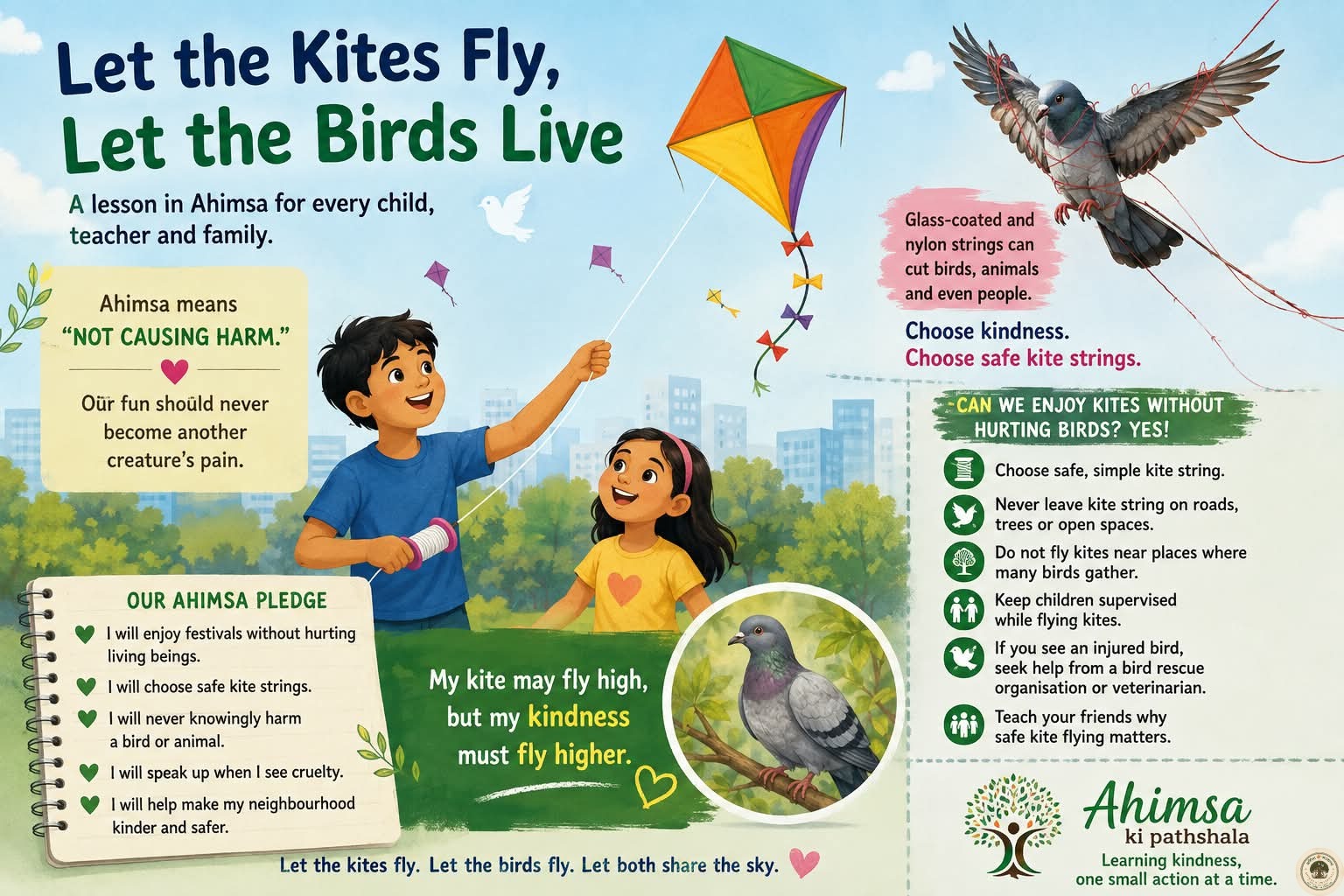
Dangerous kite strings can hurt and kill.
Nylon, glass-coated and other sharp kite strings can become invisible traps for birds. A bird flying freely may suddenly get caught in a string. Its wings, neck or body can be cut badly. People riding two-wheelers and children can also get injured by these strings.
When we see a picture of an injured bird, we may feel sad. But the real lesson is not only to feel sad.
The real lesson is to choose differently.
🌱 What does Ahimsa teach us?
Ahimsa means not causing harm.
It asks us to think about the lives around us—not only human lives, but also birds, animals, trees and all of nature.
Before buying or flying a kite, we can ask:
“Can my fun cause pain to another living being?”
If the answer is yes, we can find a kinder way.
🪁 Can we enjoy kites without hurting birds?
Yes!
Choose safe, simple kite string instead of sharp or glass-coated string.
Never leave kite string lying on roads, trees or open spaces.
Do not fly kites near places where many birds gather.
Keep children supervised while flying kites.
If you see an injured bird, tell an adult and seek help from a bird rescue organisation or veterinarian.
Teach your friends why safe kite flying matters.
🏫 A simple activity for Ahimsa Ki Pathshala
Ask students to complete this sentence:
“I can show Ahimsa to birds by ____.”
Let every child write one answer and make a small drawing.
Then create a classroom message:
“My kite may fly high, but my kindness must fly higher.” 🕊️
Festivals are meant to bring happiness.
Let us make sure that our happiness does not become another creature’s suffering.
At Ahimsa Ki Pathshala, we learn that kindness is not just a lesson we read—it is a choice we make.
Let the kites fly.
Let the birds fly.
Let both share the sky.